
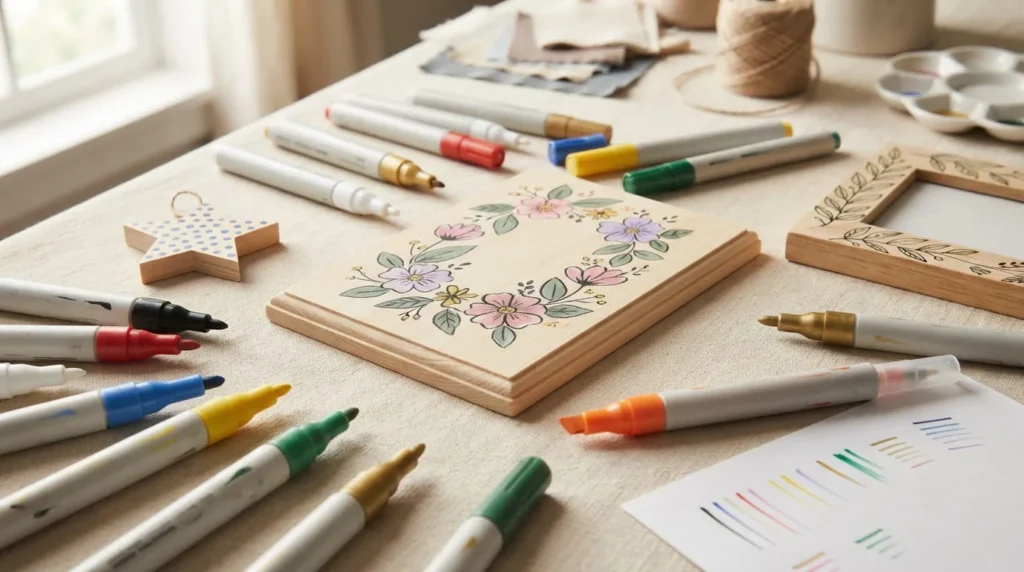
Choosing the best acrylic paint pens for wood crafts can make decorating wooden signs, ornaments, picture frames, and handmade gifts much easier. The right markers help you draw neat lines, add colorful details, and create beautiful designs without using traditional paintbrushes.
However, not every acrylic paint pen is equally suitable for every wooden project. Some have fine tips for detailed artwork, while others have broader tips for coloring larger surfaces. Wood grain, paint coverage, and surface preparation can also affect your results.
Whether you are decorating your first wooden ornament or making personalized gifts, choosing suitable markers is an important starting point.
In this guide, we will compare seven acrylic paint marker options from POSCA, ARTISTRO, and edding. You will learn about their features, advantages, limitations, and which types of wooden crafts they are best suited for.
Quick Picks: Best Acrylic Paint Pens for Wood Crafts
If you want to start decorating wood without comparing every marker in detail, these recommendations can help you narrow your choices.
Each option is selected based on its documented features, tip design, and suitability for different wooden craft projects.
Best Overall for General Wood Crafts
Uni POSCA PC-5M Acrylic Paint Markers are a versatile choice for general wooden decorations.
Their medium bullet tip works well for drawing outlines, coloring small shapes, and creating decorative patterns.
They are particularly suitable for beginners who want one marker style for several different craft activities.
Best for Fine Details
Uni POSCA PC-3M Acrylic Paint Markers are a practical choice for smaller designs.
Their finer tip is useful for drawing delicate outlines, adding details to flowers, and creating decorative borders on wooden ornaments.
They are better suited to detailed work than filling large areas.
Best Dual Tip Set for Beginners
ARTISTRO 24 Dual Tip Acrylic Paint Markers with Brush and Fine Tips offer two drawing options in one marker.
The fine tip helps with outlines and small details, while the brush tip provides flexibility for coloring and decorative strokes.
This makes the set appealing to beginners who enjoy different crafting techniques.
Best for Dots and Decorative Patterns
ARTISTRO 24 Precision Dual Tip Acrylic Paint Markers are useful for creating dots, simple patterns, and small decorative elements.
Their fine and dot tip combination allows you to switch between detailed lines and rounded marks.
They are particularly suitable for decorating wooden ornaments and small craft pieces.
Best for Broad Coloring
The edding 5000 Acrylic Marker is designed for painting larger areas.
Its broad chisel tip helps cover wider shapes and sections more easily than fine-tip markers.
It is worth considering for wooden signs, larger decorative patterns, and projects where detailed outlines are not the main priority.
Best Acrylic Paint Pens for Wood Crafts Compared
Different acrylic paint markers have different strengths. Some are better suited to detailed drawings, while others are more convenient for larger decorative projects.
The comparison below highlights the main differences between our selected products.
| Acrylic Paint Marker | Tip Type | Best For | Main Limitation |
|---|---|---|---|
| Uni POSCA PC-5M | Medium bullet tip | General wooden crafts | Less suitable for very fine details |
| Uni POSCA PC-3M | Fine bullet tip | Small outlines and details | Slow for large areas |
| ARTISTRO 24 Dual Tip Brush + Fine | Brush and fine tips | Versatile beginner projects | Brush tip needs practice |
| ARTISTRO 24 Precision Dual Tip | Dot and fine tips | Dots and decorative patterns | Less convenient for broad, even fills |
| edding 5300 | Fine round tip | Detailed lines and lettering | Limited coverage per stroke |
| edding 5100 | Medium round tip | Everyday craft drawing | Less efficient for large areas |
| edding 5000 | Broad chisel tip | Large shapes and lettering | Difficult for tiny details |
All seven options are associated with manufacturer-supported wood applications.
However, this comparison describes their features and intended uses. It does not represent laboratory testing or a measured performance ranking.
The condition of your wood, the amount of paint applied, and your preferred drawing technique can all influence the final result.
Best Acrylic Paint Pens for Wood Crafts: Detailed Reviews
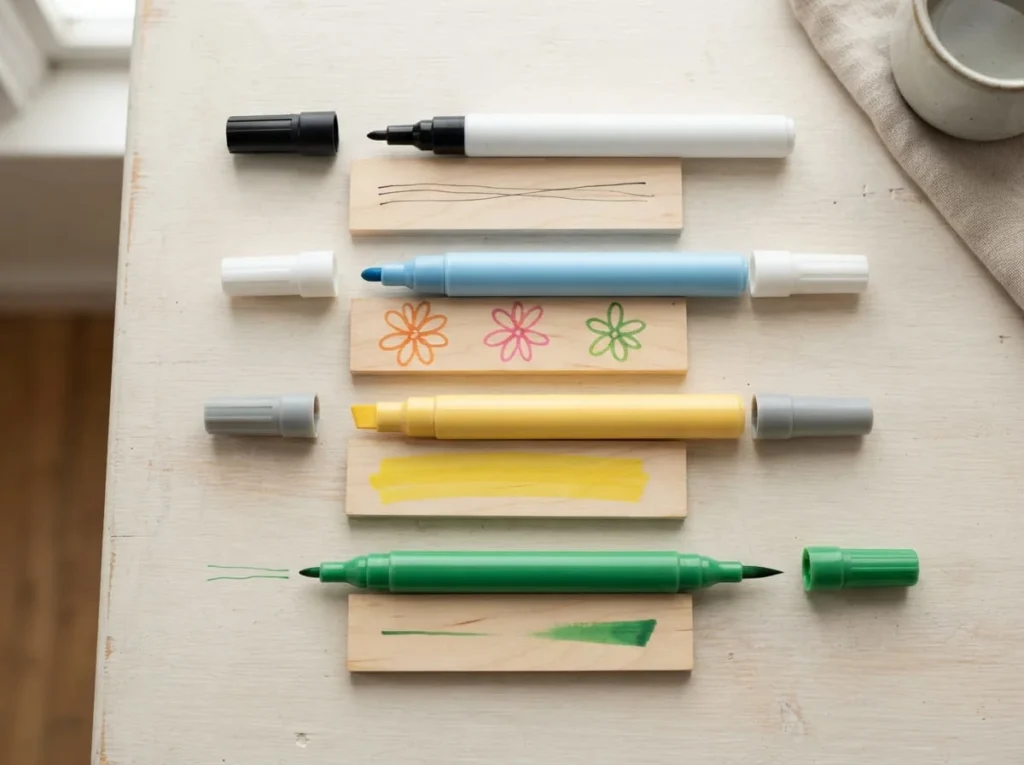
Acrylic paint markers can look similar, but the type of nib and paint delivery system can make a difference when decorating wood.
Before choosing a set, think about whether you want to draw fine details, paint larger shapes, create decorative dots, or complete several different types of projects.
Here is a closer look at seven options worth considering.
1. Uni POSCA PC-5M Acrylic Paint Markers — Best Overall for General Wood Crafts
Uni POSCA PC-5M Acrylic Paint Markers are a versatile option for decorating wooden crafts.
Their medium bullet tip offers a useful balance between drawing controlled lines and coloring moderately sized shapes.
This makes them suitable for people who want to decorate different wooden items without needing several marker styles.
Key Features
The POSCA PC-5M has a medium bullet tip with a manufacturer-specified line width of approximately 1.8 to 2.5 mm.
The marker uses water-based pigment paint and is designed for creative projects on various compatible surfaces, including wood.
POSCA markers are available in a broad selection of colors, making it possible to choose shades for flowers, geometric patterns, lettering, and other designs.
The marker requires preparation according to the manufacturer’s instructions before use.
What Makes These Pens Suitable for Wood Crafts?
The main advantage of the PC-5M is its versatility.
A medium tip allows you to create noticeable outlines without making every line too thick.
For example, you could use these markers to paint colorful flowers on a wooden box, add decorative borders to picture frames, or draw simple shapes on wooden ornaments.
The tip can also fill smaller areas without requiring as many strokes as a fine marker.
However, wood preparation remains important.
On rough or highly absorbent wood, paint may spread or produce uneven coverage. A smooth, properly prepared surface can make drawing easier.
Advantages and Limitations
Advantages:
- Versatile medium bullet tip
- Suitable for many decorative wooden projects
- Useful for outlines and small areas of color
- Wide range of available colors
- Appropriate for beginners and experienced crafters
Limitations:
- Not ideal for very small lettering or delicate details
- Filling large wooden boards can take time
- Porous wood may need additional preparation or paint layers
- Requires proper activation and care
Who Should Choose These Pens?
POSCA PC-5M markers are worth considering if you want one general-purpose marker style for different wooden craft projects.
They are particularly suitable for beginners decorating ornaments, small signs, wooden boxes, and picture frames.
If your projects involve extremely fine details, you may prefer the smaller PC-3M tip.
2. Uni POSCA PC-3M Acrylic Paint Markers — Best for Fine Details
Uni POSCA PC-3M Acrylic Paint Markers are designed for drawing more precise lines and smaller decorative elements.
They are useful when you want to add details that may be difficult to create with a broader marker.
For wooden crafts, this can include tiny flowers, thin borders, small lettering, and detailed patterns.
Key Features
The POSCA PC-3M has a fine bullet tip with a manufacturer-specified line width of approximately 0.9 to 1.3 mm.
Like other compatible POSCA paint markers, it uses water-based pigment paint.
Its narrower nib gives users more control when working on smaller shapes.
The markers are available in different colors and can be used on wood when the surface is suitable.
Best Wooden Craft Applications
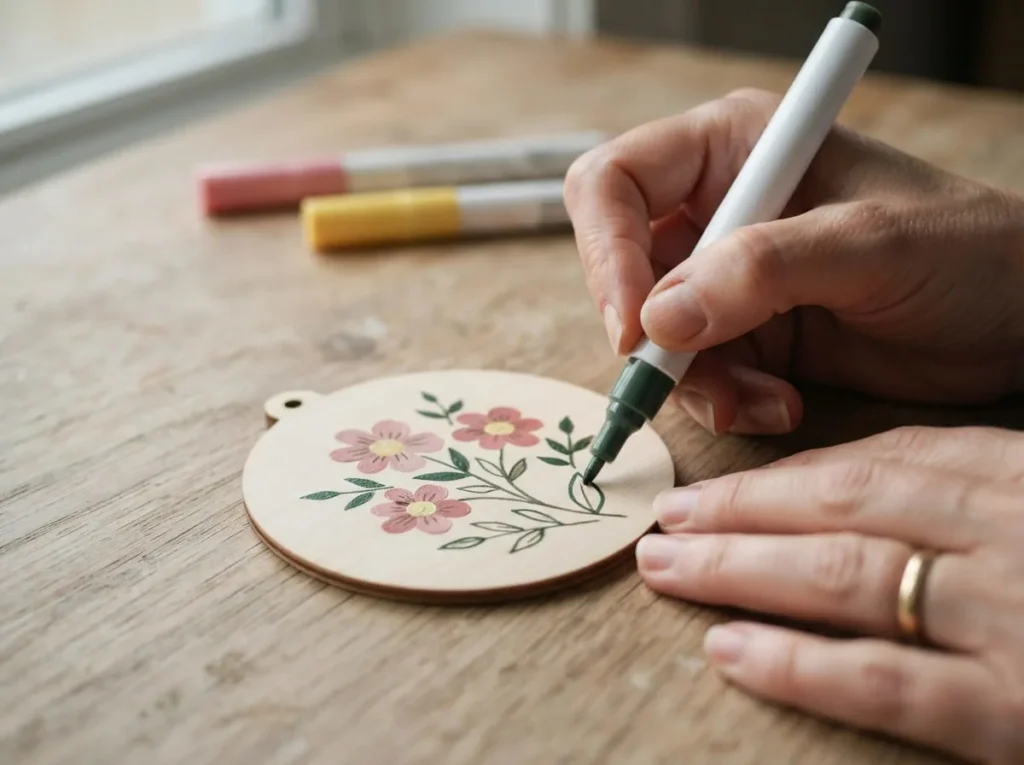
The PC-3M is particularly useful for decorating small wooden pieces.
For example, you could draw tiny leaves around the edge of a wooden ornament or add fine outlines to a painted flower.
It can also help create small decorative dots, curved lines, and simple lettering.
On a larger wooden sign, a fine-tip marker may be useful for adding finishing details after the main design has been completed.
However, fine nibs can catch on rough wood grain, so surface preparation is important.
Advantages and Limitations
Advantages:
- Fine tip for controlled drawing
- Useful for small letters and delicate details
- Suitable for intricate decorative patterns
- Helpful for outlining painted shapes
- Wide choice of colors
Limitations:
- Not efficient for filling large wooden areas
- Rough wood may interrupt narrow lines
- Detailed drawing requires patience
- May need additional coats on absorbent surfaces
Who Should Choose These Pens?
Choose POSCA PC-3M markers if your wooden projects involve small designs or detailed artwork.
They are especially useful for personalized ornaments, decorative borders, small floral patterns, and other projects where precision matters more than coverage speed.
3. ARTISTRO 24 Dual Tip Acrylic Paint Markers — Best Versatile Beginner Set
ARTISTRO 24 Dual Tip Acrylic Paint Markers with Brush and Fine Tips are designed for people who want more than one drawing style.
Each marker has two different ends, allowing you to switch between fine details and flexible brush strokes.
This can be convenient when decorating wooden crafts that combine outlines and colored shapes.
Key Features
The ARTISTRO 24 Brush and Fine Tip set includes 24 acrylic paint markers.
According to the manufacturer’s product description, the markers have a 1 mm fine tip and a flexible brush tip that produces strokes of varying widths.
The markers contain water-based acrylic paint and are advertised for multiple surfaces, including wood.
Another feature is their pre-activated cotton nibs, which do not require the traditional pumping process used by many valve-action paint markers.
Why Dual Tips Are Useful for Wooden Crafts
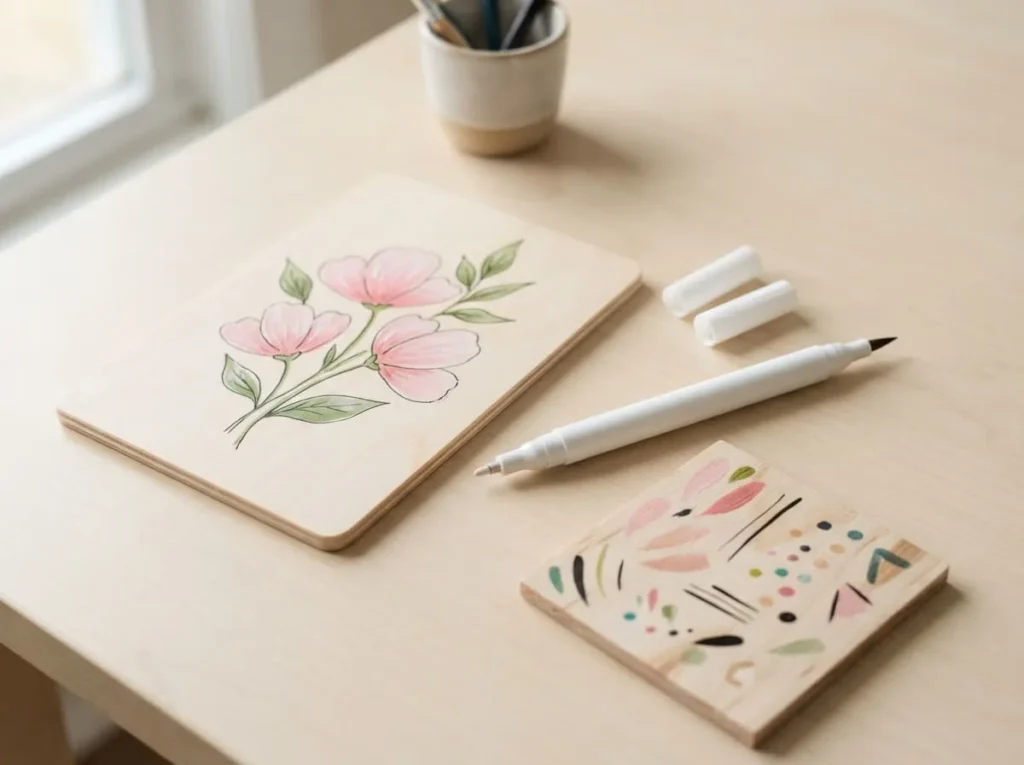
The two tips make it easier to switch between different types of marks without changing markers.
For example, you could use the brush tip to color a flower petal and then switch to the fine tip to draw its outline.
The same marker may also help you create simple lettering, leaves, curved strokes, and decorative patterns.
For beginners, having both options can be useful when experimenting with different crafting styles.
However, a flexible brush tip requires some practice because changes in hand pressure can affect the width of your strokes.
On rough wood, the surface texture may also make brush strokes less consistent.
Advantages and Limitations
Advantages:
- Two tip styles in each marker
- Useful for both outlines and coloring
- Includes 24 colors
- Manufacturer describes the nibs as ready to use
- Suitable for various beginner craft projects
Limitations:
- Brush-tip control may take practice
- Rough wood grain can affect flexible strokes
- Not as convenient as a broad chisel marker for large flat areas
- Color coverage may vary with the wooden surface
Who Should Choose These Pens?
ARTISTRO Brush and Fine Dual Tip markers are a practical option for beginners who enjoy experimenting with different designs.
They are particularly suitable for decorative wooden boxes, gift tags, picture frames, and ornaments featuring both detailed lines and colorful shapes.
4. ARTISTRO 24 Precision Dual Tip Acrylic Paint Markers — Best for Decorative Patterns
ARTISTRO Precision Dual Tip Acrylic Paint Markers are useful for people who enjoy making dots, repeated patterns, and smaller decorative designs.
The fine and dot tip combination offers a different drawing experience from the brush and fine set.
This makes the markers worth considering for certain wooden craft projects.
Key Features
ARTISTRO offers a 24-color metallic precision set with a 1 mm fine tip and a dot tip designed for wider rounded marks.
The manufacturer describes these as water-based acrylic markers with pre-activated nibs.
Wood is among the materials listed for use with the markers.
The metallic color selection also makes this particular set relevant for decorative crafts where shimmering shades are desired.
Best Wooden Craft Applications
Dot patterns can make simple wooden objects look more decorative without requiring advanced painting skills.
For example, you could add rows of colored dots around a wooden heart or decorate a small wooden ornament with circular patterns.
The fine tip can then be used for outlines, tiny flowers, and smaller shapes.
You can also combine dots and lines to create simple geometric designs.
These markers are useful for projects where the artwork consists mainly of small marks rather than large filled sections.
Advantages and Limitations
Advantages:
- Fine and dot tips in one marker
- Useful for decorative dots and small patterns
- Manufacturer-supported wood compatibility
- Pre-activated nib design
- Metallic color options for decorative effects
Limitations:
- Less convenient for filling broad areas evenly
- Dot sizes may vary with pressure and technique
- Metallic colors may appear different on light and dark wood
- Fine details work best on smooth surfaces
Who Should Choose These Pens?
Choose ARTISTRO Precision Dual Tip markers if you enjoy decorating wooden ornaments, gift tags, and small craft pieces with dots and detailed patterns.
They are particularly useful when you want decorative effects rather than broad coloring.
5. edding 5300 Acrylic Marker — Best for Fine Decorative Lines
The edding 5300 Acrylic Marker is another option for detailed wooden artwork.
It is designed with a fine round nib and contains pigmented water-based acrylic paint.
The manufacturer identifies wood among the suitable materials for this marker.
Key Features
The edding 5300 has a fine round nib with a specified stroke width of approximately 1 to 2 mm.
It contains water-based acrylic paint and is available in several colors and coverage styles.
According to edding, its acrylic markers are intended for artwork on materials including wood, stone, canvas, and painting paper.
The marker uses a pump-action system and should be activated according to the manufacturer’s instructions.
Best Wooden Craft Applications
The fine nib makes the edding 5300 suitable for thin outlines, delicate patterns, and small lettering.
For example, you could add decorative leaves to a wooden frame or draw fine details inside a painted flower.
It can also be useful when creating narrow borders around wooden signs.
Because the tip is relatively small, it allows more control over fine details than a broad chisel marker.
A smooth wooden surface is important for creating consistent lines.
Advantages and Limitations
Advantages:
- Fine round nib for detailed drawing
- Manufacturer-supported wood use
- Pigmented water-based acrylic paint
- Useful for thin lines and decorative details
- Suitable for combining with broader acrylic markers
Limitations:
- Filling large shapes can be time-consuming
- Rough wood may interrupt fine lines
- Requires activation before use
- Some colors have different levels of coverage
Who Should Choose This Marker?
The edding 5300 is suitable for crafters who want controlled decorative lines on wooden objects.
It is worth considering for lettering, small floral designs, borders, and finishing details.
6. edding 5100 Acrylic Marker — Best for Everyday Wood Craft Drawing
The edding 5100 Acrylic Marker is designed for general drawing and coloring on different suitable surfaces, including wood.
Its medium round nib offers a balance between detailed drawing and filling smaller shapes.
This makes it a practical option for common wooden craft projects.
Key Features
The edding 5100 has a round nib with a specified stroke width of approximately 2 to 3 mm.
It contains water-based acrylic paint and is offered in a range of colors.
The manufacturer identifies wood as a suitable material and describes the paint as lightfast and permanent after drying.
However, durability still depends on the surface, preparation, and intended use.
Best Wooden Craft Applications
A medium-tip marker can be helpful when decorating wooden signs, ornaments, small boxes, and craft boards.
For example, you could draw colorful shapes on a wooden plaque or create a simple border around a picture frame.
The tip can fill moderately sized areas while remaining useful for general outlines.
If your design includes both large shapes and tiny details, you may want to combine this marker with a finer option.
Advantages and Limitations
Advantages:
- Medium round tip for general drawing
- Suitable for various wooden crafts
- Manufacturer-supported wood compatibility
- Useful for outlines and smaller areas of color
- Can complement fine and broad markers
Limitations:
- Not ideal for extremely delicate details
- Less efficient for very large areas
- Requires proper activation
- Results can vary on rough or porous wood
Who Should Choose This Marker?
The edding 5100 is worth considering if you mainly decorate small or medium wooden craft pieces.
It is suitable for beginners who want a practical marker for everyday patterns, outlines, and colorful designs.
7. edding 5000 Acrylic Marker — Best for Larger Colored Areas
The edding 5000 Acrylic Marker is designed for projects that require broader strokes and larger areas of color.
Unlike fine and medium round-tip markers, it has a wide chisel nib.
This makes it useful for wooden craft projects where covering more space is important.
Key Features
The edding 5000 has a broad chisel tip with a manufacturer-specified stroke width of approximately 5 to 10 mm.
It contains pigmented water-based acrylic paint and is intended for suitable materials including wood.
The wider tip produces broader strokes than the edding 5100 and 5300.
Like other pump-action markers in this range, it requires proper activation before use.
Best Wooden Craft Applications
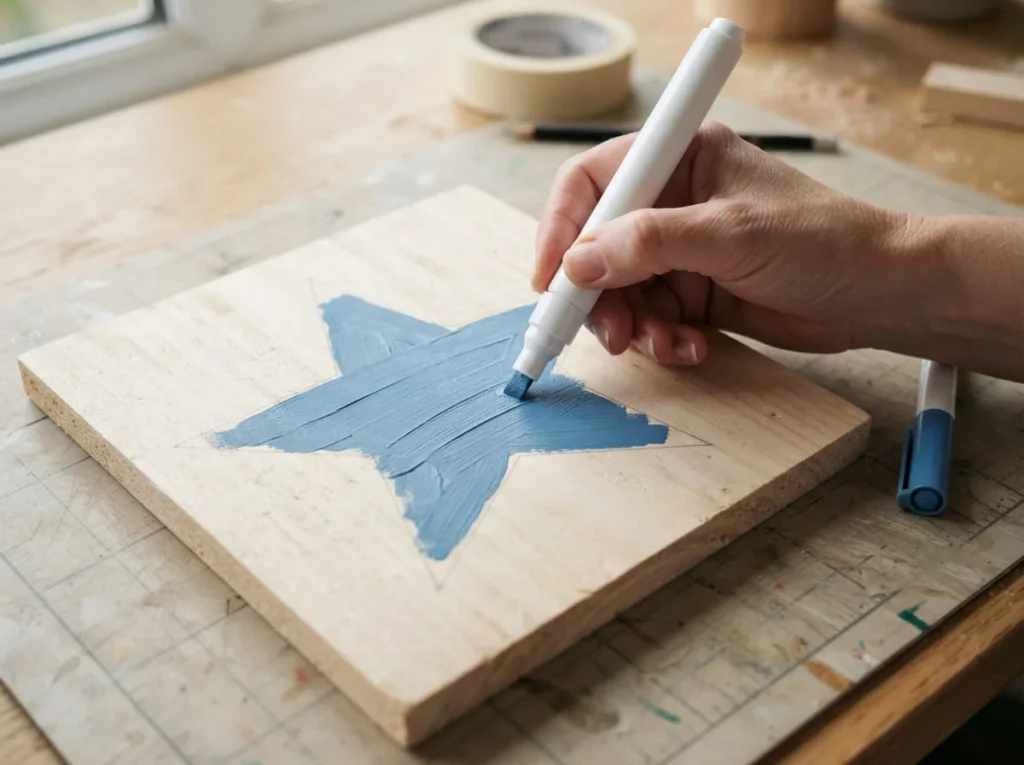
Broad acrylic markers are useful for filling large decorative letters, geometric shapes, and sections of wooden signs.
For example, you might use the edding 5000 to color a large star on a wooden board or fill the background of a simple handmade decoration.
The wide chisel nib can help cover an area using fewer strokes than a fine marker.
However, working around narrow corners and delicate outlines can be more difficult with a broad tip.
For projects involving small details, combining it with a fine or medium marker may be more convenient.
Advantages and Limitations
Advantages:
- Broad chisel tip for larger shapes
- Useful for coloring wide sections
- Manufacturer-supported wood compatibility
- Suitable for bold decorative patterns
- Can complement finer markers
Limitations:
- Not suitable for very small lettering
- Difficult to use in narrow decorative spaces
- Large painted sections may still require several passes
- Paint coverage depends on wood preparation and absorption
Who Should Choose This Marker?
The edding 5000 is worth considering if you enjoy making larger wooden signs, bold decorative patterns, and craft projects with wide areas of color.
It is less convenient for tiny details, but it can work well alongside a finer marker when a project requires different stroke sizes.
How to Choose the Best Acrylic Paint Pens for Wood Crafts
Choosing acrylic paint pens for wood crafts is not just about finding a set with beautiful colors. The tip size, paint coverage, wood compatibility, and ease of use can all affect your experience.
A marker that works well for detailed lettering may not be the best choice for coloring a large wooden sign. Similarly, a broad-tip marker may cover large shapes quickly but make small details difficult.
Before buying a set, think about the wooden projects you want to create and which features will help you complete them.
Choose Pens Designed for Wooden Surfaces
Start by checking whether the acrylic paint pens are suitable for wood.
Some markers are designed for paper, while others can be used on wood, stone, canvas, glass, and additional craft materials.
Look for information about wood compatibility in the manufacturer’s product description.
Keep in mind that different types of wood can produce different results.
Unfinished wood may absorb paint and cause uneven coverage, while previously varnished wood may make adhesion more difficult.
Choosing a compatible marker is important, but proper surface preparation also affects the final design.
Consider the Tip Size and Shape
The tip is one of the most important features to consider when choosing acrylic paint pens.
Different tip styles help you create different types of marks.
Fine Tips for Lettering and Small Details
Fine-tip acrylic paint pens are useful for small letters, delicate flowers, thin outlines, and decorative patterns.
They allow you to work in narrow spaces and add small details to wooden ornaments.
However, fine tips are less convenient for filling large areas.
They may also catch on rough wood grain, so a smooth surface is especially helpful.
Medium Tips for Everyday Wooden Crafts
Medium-tip markers are a practical choice for many beginner projects.
They can create visible outlines, fill smaller shapes, and draw simple decorative patterns.
For example, a medium-tip pen can be useful when painting flowers on wooden boxes or adding colorful borders to picture frames.
If you are unsure which tip size to choose, a medium tip is often a useful starting point.
Broad Tips for Filling Larger Shapes
Broad-tip acrylic paint markers are designed to create wider strokes.
They can help fill large letters, geometric patterns, and decorative shapes using fewer strokes than a fine-tip marker.
This makes them useful for wooden signs and larger craft boards.
However, broad tips are more difficult to control when working on tiny details or narrow corners.
Brush and Dual Tips for Flexible Designs
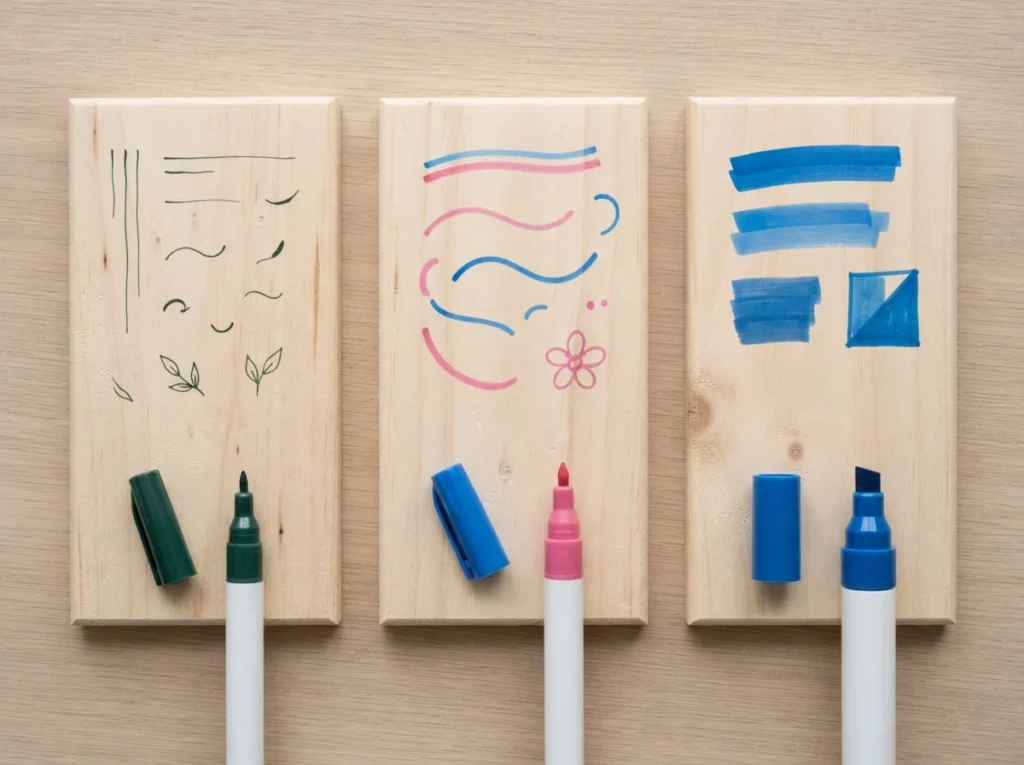
Brush-tip markers have flexible nibs that can create strokes of different widths.
They are useful for curved lines, leaves, petals, and decorative lettering.
Dual-tip markers provide two drawing options in one pen, such as a fine tip and a brush tip.
This can be convenient when a project includes both small outlines and larger colored shapes.
However, flexible tips may require additional practice, particularly on textured wooden surfaces.
Check Paint Opacity and Color Coverage
Paint opacity determines how well a color hides the surface underneath.
This matters when decorating dark wood or creating bright designs on natural wooden pieces.
Some acrylic paint markers produce opaque colors that stand out clearly, while others may require additional layers.
Even opaque paint can appear uneven on highly absorbent wood.
If you plan to decorate dark wooden objects, look for suitable markers with strong color coverage and test them before beginning.
A compatible light-colored base coat may also help colors appear brighter.
Remember that the final appearance depends on both the paint and the wooden surface.
Think About Color Selection
A large marker set may look attractive, but you do not always need many colors.
For simple wooden decorations, a small collection of useful shades may be enough.
For example, green, pink, yellow, white, and black can be used for flowers, leaves, outlines, and small decorative patterns.
If you enjoy making seasonal crafts or colorful illustrations, a larger set may offer more flexibility.
Think about the designs you actually plan to create.
Buying colors you will regularly use is often more practical than choosing a large collection simply because it contains more markers.
Consider Ease of Activation and Maintenance
Different acrylic paint markers use different paint delivery systems.
Some have pump-action nibs that need to be activated before use.
Others have pre-activated tips that are intended to begin writing without the same pumping process.
If you are a beginner, consider which system feels easier to manage.
You should also check whether the marker requires particular cleaning or storage methods.
A convenient marker is one that you can prepare, use, and maintain according to its instructions without unnecessary difficulty.
Compare Value Instead of Color Count Alone
The largest acrylic paint pen set is not automatically the best value.
A smaller collection with suitable tip sizes and useful colors may be more practical for your projects.
When comparing sets, consider the number of markers, available colors, tip styles, wood compatibility, and any documented maintenance features.
Think about how frequently you will use the pens.
For occasional decorations, a basic set may meet your needs.
If you regularly create detailed wooden artwork, investing in markers that suit your preferred techniques may be worthwhile.
The best value comes from choosing supplies you will actually use.
Which Acrylic Paint Pens Are Best for Different Wood Craft Projects?
Different wooden crafts require different levels of detail and paint coverage.
A marker that works well for a large wooden sign may feel too thick for a tiny ornament.
Choosing your pens according to the project can make drawing easier and help you avoid buying unnecessary supplies.
Best Paint Pens for Wooden Signs
Wooden signs often contain lettering, decorative borders, and large colored shapes.
Medium-tip markers such as the POSCA PC-5M or edding 5100 are worth considering for general drawing and moderately sized lettering.
For larger letters and bold designs, a broad-tip marker such as the edding 5000 may be more convenient.
If the sign includes small decorative details, you may also need a fine-tip marker.
Choose your markers according to the size and complexity of the sign.
Best Paint Pens for Wooden Ornaments
Wooden ornaments usually have limited painting space.
Fine and medium-tip markers are useful for creating stars, flowers, hearts, and small decorative patterns.
For example, the POSCA PC-3M can help with delicate outlines, while the PC-5M can fill smaller shapes.
ARTISTRO precision dual-tip markers may also be convenient when decorating ornaments with dots and repeated patterns.
Choose smooth wooden ornaments whenever possible to make detailed drawing easier.
Best Paint Pens for Wooden Picture Frames
Wooden picture frames often have narrow borders and corners that require controlled drawing.
Fine-tip acrylic paint pens are useful for adding tiny flowers, leaves, dots, and decorative lines.
The edding 5300 and POSCA PC-3M are suitable options to consider for this type of work.
If your frame has wider wooden borders, a medium-tip marker may help with larger patterns.
Keep the design simple so it complements the frame without covering every available space.
Best Paint Pens for Wood Slices
Natural wood slices are popular for rustic ornaments and handmade decorations.
However, their grain and porosity can make painting more challenging.
Medium-tip markers are often a practical choice for simple shapes and outlines.
For smaller details, fine-tip markers may work well after the surface has been appropriately prepared.
If the wood is highly absorbent, test the markers before starting your design.
A suitable base coat may improve coverage, although it can hide some of the natural wood grain.
Best Paint Pens for Detailed Wooden Artwork
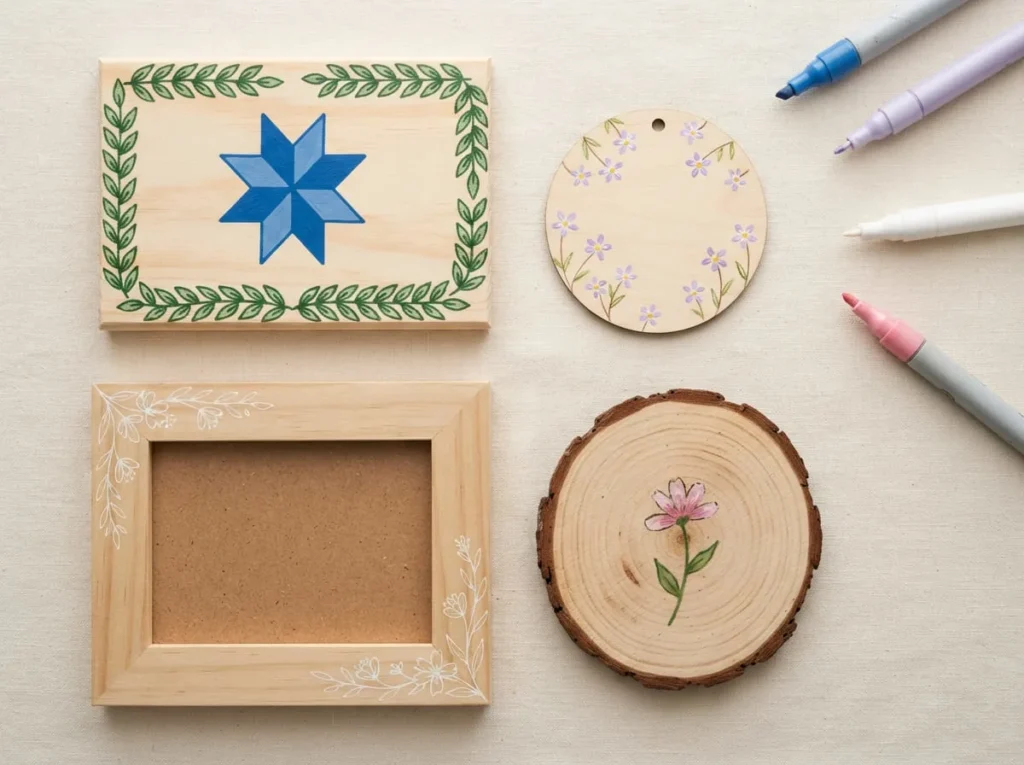
Detailed wooden artwork requires markers that allow precise control.
Fine-tip options such as the POSCA PC-3M and edding 5300 are worth considering for thin lines, small floral patterns, and decorative elements.
A fine and brush dual-tip set may also be useful when your artwork combines delicate outlines with flexible strokes.
Choose a smooth wooden surface and test your markers before beginning.
For larger areas within a detailed design, you can combine fine-tip markers with medium or broader options.
Do Acrylic Paint Pens Work Better on Unfinished or Painted Wood?
Acrylic paint pens can work on different wooden surfaces, but the results are not always the same.
The condition of the wood affects how paint spreads, how colors appear, and how well the finished design adheres.
Before choosing markers for a project, consider whether the wood is unfinished, primed, painted, or varnished.
Acrylic Paint Pens on Unfinished Wood
Unfinished wood has natural pores that can absorb liquid paint.
This may cause colors to look lighter or lines to spread slightly along the grain.
Acrylic paint pens suitable for wood can often be used directly on smooth unfinished surfaces.
However, rough or highly absorbent wood may need additional preparation.
For example, you may need to gently sand the surface or apply a compatible base coat.
Test your chosen marker on a small area before decorating the entire piece.
Acrylic Paint Pens on Primed Wood
Primed wood can provide a more even surface for acrylic paint markers.
A suitable primer may reduce paint absorption and help colors appear more consistent.
This can be useful when working with dark wooden surfaces or creating designs that require clear outlines.
However, the primer must be compatible with both the wood and your chosen paint markers.
Allow it to dry or cure according to the manufacturer’s instructions before drawing.
Even on primed wood, testing your marker first is a good idea.
Acrylic Paint Pens on Painted Wood
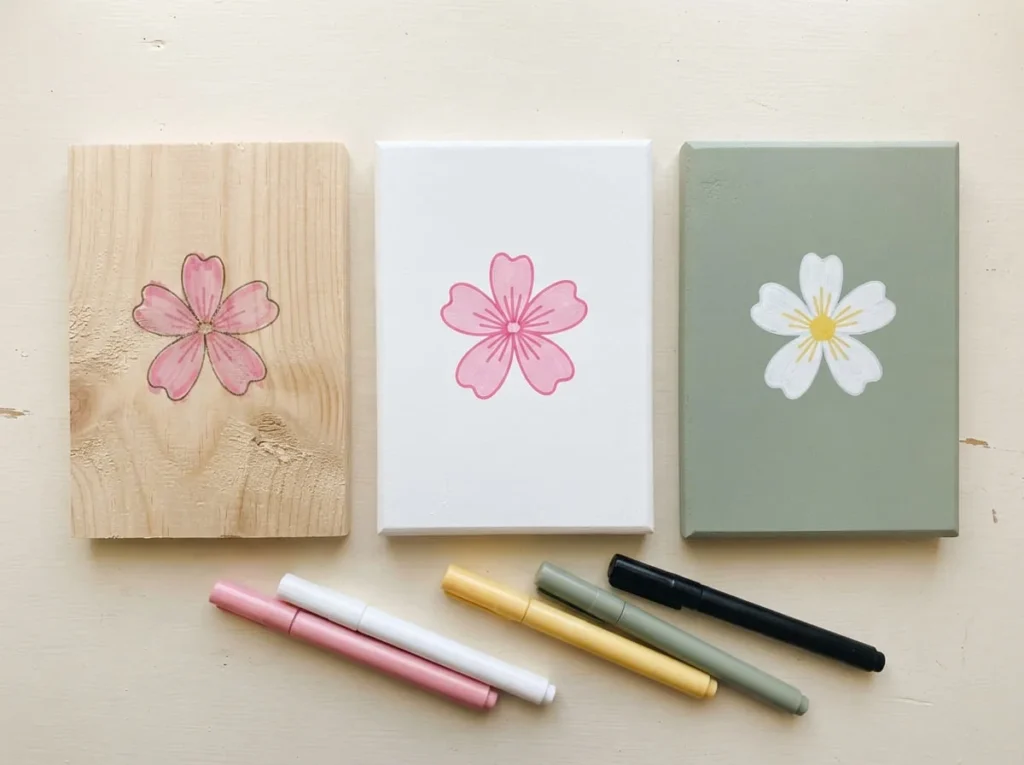
You can use compatible acrylic paint pens to decorate wooden surfaces that have already been painted.
For example, you might add flowers to a painted box or draw decorative details on a wooden frame.
Make sure the existing paint is clean, dry, and firmly attached.
Some matte painted surfaces provide a suitable base for additional artwork.
Glossy finishes may be more challenging because they can reduce paint adhesion.
Check compatibility before applying your markers, especially when decorating an object with an unknown existing coating.
Acrylic Paint Pens on Varnished Wood
Varnished wood usually has a protective coating that makes the surface less absorbent.
This can create adhesion problems for certain acrylic paint pens.
The marker may appear to work initially, but the paint could scratch or peel if it does not bond properly with the finish.
Some varnished surfaces may require special preparation or a compatible bonding primer.
However, sanding or altering an existing finish can permanently change the appearance of the wooden object.
Always check the manufacturer’s recommendations and test your chosen marker on a small, inconspicuous area.
For a more detailed explanation of wood preparation and painting techniques, our article Acrylic Paint Pens on Wood covers the process step by step.
Are Expensive Acrylic Paint Pens Better for Wood Crafts?
Expensive acrylic paint pens are not always better for every wooden craft project. The right choice depends on what you want to create, how often you use the markers, and which features matter most to you.
Some higher-priced markers offer specialized tips, additional color choices, or replaceable parts. However, affordable acrylic paint pens can also be suitable for simple decorations when they are compatible with wood.
Instead of focusing only on price, compare the features you will actually use.
What You May Get from Higher-Priced Markers
Some higher-priced acrylic paint markers offer features that may be useful for frequent crafting.
Depending on the brand and model, these can include specialized nibs, replaceable tips, refillable designs, or a wider selection of individual colors.
These features can be helpful when you regularly create wooden signs, personalized ornaments, or detailed artwork.
For example, a replaceable nib may be useful if you frequently work on textured surfaces that cause additional tip wear.
However, these benefits vary between products. A higher price does not automatically guarantee stronger color coverage or better adhesion to wood.
Always check the manufacturer’s specifications before deciding whether the additional cost is worthwhile.
When Affordable Paint Pens Are Enough
Affordable acrylic paint pens can be a practical choice for beginners and occasional craft projects.
If you want to decorate a few wooden ornaments, paint simple flowers on a picture frame, or create small handmade gifts, you may not need an expensive marker collection.
A basic set with suitable tip sizes and a useful selection of colors may be enough.
The important thing is to choose markers that are recommended for wooden surfaces.
An affordable marker used on properly prepared wood may produce a more satisfactory result than a more expensive marker used on an unsuitable surface.
When Spending More Makes Sense
Spending more on acrylic paint pens may be worthwhile when you use them frequently or need particular features.
For example, detailed wooden artwork may benefit from carefully selected fine-tip markers.
If you regularly create signs with larger colored sections, purchasing suitable broad-tip markers could make your work easier.
You may also prefer products that offer individual replacement colors or compatible replacement nibs.
Before paying more, consider whether the additional features will improve the projects you actually make.
Common Mistakes When Buying Acrylic Paint Pens for Wood
Buying acrylic paint pens can feel simple until you start comparing different brands, tips, and color sets.
Some beginners choose markers based only on their packaging or the number of colors included.
However, a few common buying mistakes can make wooden craft projects more difficult than necessary.
Understanding these mistakes can help you choose supplies that suit your needs.
Choosing Pens Without Checking Wood Compatibility
One of the biggest mistakes is assuming that every acrylic paint pen works equally well on wood.
Some markers are intended for particular materials, while others are suitable for several craft surfaces.
Before purchasing, check the manufacturer’s recommendations.
Look for clear information confirming that the markers can be used on wood.
If you plan to decorate painted or varnished wooden objects, remember that the existing finish can also affect adhesion.
Buying Only Fine Tips for Large Projects
Fine-tip markers are useful for delicate details, but they can make large projects time-consuming.
For example, filling a large wooden letter using a very narrow nib may require many individual strokes.
This can create uneven coverage if the paint begins drying before you finish the area.
If you regularly decorate larger wooden signs or boards, consider including medium or broad-tip markers in your collection.
Choose the tip size according to the amount of surface you need to cover.
Ignoring Wood Grain and Surface Preparation
Even suitable acrylic paint pens may produce uneven results on rough or highly absorbent wood.
Some beginners assume that buying a more expensive marker will automatically solve these problems.
However, wood grain, dust, and existing coatings can affect paint application regardless of the brand.
Choose smooth wooden craft pieces whenever possible.
If the surface requires preparation, follow an appropriate cleaning, sanding, or priming method before painting.
Testing the marker on a small area can also help you identify potential problems.
Choosing a Large Set Without Considering Useful Colors
A large collection of acrylic paint pens may seem like a better deal, but you might only use a few colors regularly.
For example, someone who mainly paints simple floral decorations may use green, pink, yellow, white, and black more often than unusual specialty shades.
Before purchasing a large set, consider your preferred designs.
Choose a color collection that matches the projects you want to create.
A smaller set with useful colors can sometimes be a more practical purchase.
Assuming Every Acrylic Paint Pen Is Waterproof
Not every acrylic paint pen creates a waterproof finish on wood.
Some markers provide durable decorative color after drying, but that does not necessarily mean they can withstand repeated washing, outdoor weather, or prolonged moisture exposure.
If you plan to decorate wooden items for outdoor use, check whether the markers are suitable for that purpose.
A compatible protective coating may improve resistance to certain conditions, but it does not automatically make every painted project waterproof.
Follow the manufacturer’s instructions rather than relying on the word permanent alone.
Expecting Perfect Coverage in One Coat
Some beginners expect every acrylic paint marker to produce completely even color with one application.
However, unfinished wood can absorb paint, and dark wood may affect how bright certain colors appear.
Even suitable opaque markers may require another layer on some surfaces.
Choose paint pens with coverage characteristics appropriate for your project.
If needed, prepare the wood with a compatible base coat and allow each paint layer to dry according to the product instructions.
How to Care for Acrylic Paint Pens Used on Wood
Taking care of your acrylic paint pens can help keep them ready for future wooden craft projects.
Wood grain, dried paint, and incorrect storage can sometimes interfere with the marker tip or paint flow.
A few simple habits can help you maintain your supplies.
Clean Marker Tips When Needed
When using acrylic paint pens on wood, small wood fibers or dried paint may collect around the nib.
This can make the marker produce uneven lines.
If the tip becomes dirty, follow the manufacturer’s recommended cleaning method.
Some products have removable or washable nibs, while others require different care.
Avoid using harsh cleaning products or pulling out a nib unless the manufacturer specifically allows it.
Close Caps Properly After Use
Always replace the marker cap securely after painting.
Leaving a marker uncapped can cause paint around the tip to dry.
This may make the pen harder to use the next time you start a project.
Check that the cap is fully closed before putting the marker away.
Also, avoid leaving uncapped pens on your worktable while preparing another color.
Follow the Recommended Storage Method
Different acrylic paint markers may have different storage requirements.
Some manufacturers recommend storing markers horizontally, while other products have their own instructions.
Follow the guidance provided with your marker set.
Keep your markers away from excessive heat and direct sunlight unless the manufacturer advises otherwise.
Store them in a clean place where the caps will not become loose or damaged.
Test Pens Before Starting Another Project
Before beginning a new wooden craft, test your acrylic paint pens on scrap paper.
This helps you check whether the paint flows smoothly and whether the nib is in good condition.
If the color appears uneven, follow the manufacturer’s instructions for preparing or maintaining the marker.
Do not repeatedly press a pump-action nib directly onto your wooden project because excess paint may spread into the grain.
Testing first can help you avoid unnecessary mistakes.
Frequently Asked Questions
What Are the Best Acrylic Paint Pens for Wood Crafts?
The best acrylic paint pens for wood crafts depend on the project. Uni POSCA PC-5M and edding 5100 are versatile medium-tip options for general decorations. POSCA PC-3M and edding 5300 are worth considering for fine details, while edding 5000 is suitable for broader strokes. ARTISTRO dual-tip sets offer different drawing styles in one collection.
Are POSCA Pens Good for Wood Crafts?
Yes, POSCA paint markers are suitable for decorating wood according to the manufacturer. They are available in different tip sizes, making them useful for outlines, lettering, patterns, and colored shapes. However, unfinished wood may absorb paint, and rough surfaces can affect line quality. Proper preparation helps improve results.
Are ARTISTRO Acrylic Paint Pens Suitable for Wood?
ARTISTRO offers acrylic paint marker sets advertised for use on wood and other craft surfaces. Certain dual-tip sets combine fine, brush, or dot tips for different decorative techniques. Their suitability depends on the exact product and wooden surface. Check the manufacturer’s specifications and test the markers before starting a larger project.
What Tip Size Is Best for Painting on Wood?
Medium-tip acrylic paint pens are often a practical choice for general wooden crafts because they can draw outlines and fill smaller shapes. Fine tips are better for detailed lettering and decorative patterns, while broad tips are useful for large colored areas. Choose the tip according to your project’s size and complexity.
Can Acrylic Paint Pens Be Used on Unfinished Wood?
Yes, many acrylic paint pens can be used on smooth unfinished wood. However, natural wood pores may absorb the paint and cause lighter colors or uneven lines. Sanding rough areas and testing the marker can help. Some projects may benefit from a compatible primer or base coat before painting.
Do Acrylic Paint Pens Bleed on Wood?
Acrylic paint pens can bleed on wood when liquid paint spreads into its natural pores and fibers. This is more noticeable on highly absorbent or rough wooden surfaces. Using a suitable base coat, controlling paint flow, and choosing a smooth surface can help reduce bleeding. Always test the marker before adding fine details.
Are Acrylic Paint Pens Permanent on Wood?
Some acrylic paint pens create durable marks on properly prepared wooden surfaces after the paint has fully cured. However, permanence depends on the marker formulation, wood condition, and how the finished object is used. Paint may still scratch, fade, or wear away. Check the manufacturer’s durability guidance before choosing markers for frequently handled items.
Do You Need to Seal Acrylic Paint Pens on Wood?
Not every wooden craft requires sealing. A decorative ornament displayed indoors may need less protection than a wooden box or frequently handled sign. If additional protection is necessary, use a compatible finish recommended for the paint and wood. Allow the artwork to dry or cure properly and test the sealer before applying it.
Can You Use Acrylic Paint Pens on Outdoor Wooden Decorations?
Certain acrylic paint pens may be suitable for outdoor wooden decorations when used with an appropriate exterior finishing system. However, ordinary decorative acrylic markers are not automatically weatherproof. Rain, sunlight, and changing temperatures can affect the paint and wood. Check the manufacturer’s recommendations and choose materials intended for outdoor conditions.
Are Acrylic Paint Pens Better Than Brushes for Wood Crafts?
Acrylic paint pens can be more convenient than brushes for drawing outlines, small lettering, dots, and decorative details. They allow you to apply paint directly without dipping a brush into a separate container. However, brushes may be more practical for covering large areas or creating certain textures. Both tools can be useful depending on the wooden project.
Final Thoughts
The best acrylic paint pens for wood crafts are the ones that match your projects, preferred drawing style, and budget.
Fine-tip markers are useful for small details, medium tips work well for general decorations, and broad tips make coloring larger shapes easier. Dual-tip markers can also provide flexibility when you enjoy different techniques.
Before buying, check wood compatibility, compare the available colors, and consider the condition of the wooden surfaces you plan to decorate.
You do not need the largest or most expensive marker collection to create attractive handmade crafts.
Start with suitable supplies, practice on small wooden pieces, and gradually explore different painting techniques as your confidence grows.