
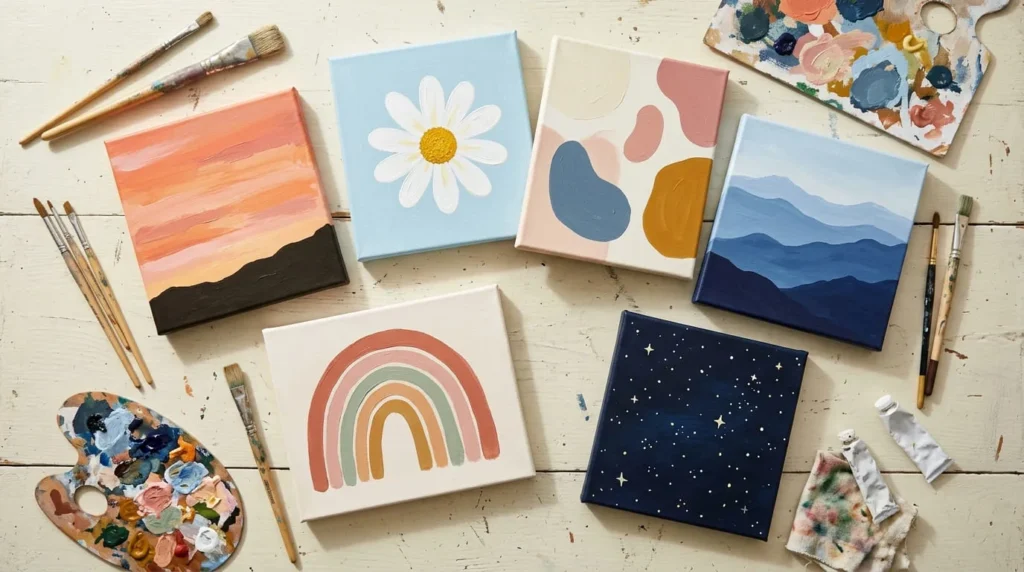
Easy canvas painting ideas with acrylic paint are a wonderful way to explore your creativity, even if you have never painted before. You do not need expensive art supplies or advanced drawing skills to create colorful artwork on canvas.
With a few basic brushes, simple acrylic colors, and a little practice, you can paint flowers, sunsets, mountains, abstract shapes, and other beautiful designs.
Acrylic paint is especially useful for beginners because you can build colors in layers, experiment with different brush strokes, and paint over many mistakes once the previous layer has dried.
The key is to start with simple ideas instead of trying to create complicated artwork immediately.
In this guide, you will discover 15 easy acrylic canvas painting ideas with clear instructions, suggested colors, and helpful beginner tips. You will also learn how to prepare your canvas and choose the supplies needed to get started.
Why Is Acrylic Paint Good for Beginner Canvas Painting?
Acrylic paint is a popular choice for beginner canvas painting because it is versatile and can be used for many different styles.
You can create colorful abstract artwork, simple landscapes, floral designs, and decorative paintings using basic techniques.
It also works well on properly prepared canvas, making it a convenient option for practicing at home.
Acrylic Paint Is Easy to Layer
One useful feature of acrylic paint is that you can apply new colors over previous layers after they have dried sufficiently.
For example, you can paint a light blue sky, allow it to dry, and then add dark mountain shapes over the background.
You can also add small details or highlights without completely changing the colors underneath.
This makes it easier to build a painting gradually.
If you make a small mistake, you can often wait for the paint to dry and cover the affected area with another suitable acrylic layer.
However, thick paint and certain colors may require additional coats to hide completely.
You Can Create Different Painting Styles
Acrylic paint allows you to experiment with several painting styles.
You can use smooth colors for simple geometric artwork or visible brush strokes for flowers and landscapes.
A flat brush can help you paint backgrounds, while a smaller round brush is useful for adding details.
You can also blend neighboring colors while the paint remains workable.
For example, combining orange and pink can create a simple sunset effect.
You do not need to master every technique before starting. Learning one or two basic methods is enough for your first canvas painting.
Acrylic Painting Does Not Require Expensive Tools
You can begin acrylic painting with a small collection of affordable supplies.
A pre-primed canvas, a few acrylic paint colors, and two or three brushes are enough for many beginner projects.
You can mix primary colors to create additional shades instead of buying a separate paint tube for every color.
A simple plate or reusable palette can hold your paint while you work.
You do not need professional painting equipment to practice basic shapes, flowers, or landscapes.
As you gain experience, you can gradually add more colors and brushes based on the techniques you enjoy.
Supplies You Need for Easy Acrylic Canvas Painting
Before trying your first painting, gather a few basic materials.
Having your supplies nearby makes it easier to focus on painting rather than searching for tools while your colors are drying.
You do not need a large collection of paints or brushes. Start with simple supplies that work well for the designs you want to create.
Choosing a Beginner-Friendly Canvas
For beginners, a ready-to-paint, pre-primed canvas is usually the easiest choice.
Two common options are stretched canvases and canvas panels.
A stretched canvas has fabric secured over a wooden frame. It provides a slightly flexible painting surface and can be displayed after the artwork is finished.
A canvas panel has primed canvas attached to a firm backing, making it convenient for practicing brush strokes and simple designs.
Both options can work well with acrylic paint when properly prepared.
Choose a canvas that gives you enough room to paint comfortably without making the project feel difficult.
Check the packaging to confirm that the surface is suitable for acrylic painting.
Basic Acrylic Paint Colors
You do not need dozens of colors to start painting.
A small collection of acrylic paints can provide many different combinations.
Useful beginner colors include:
- Red or magenta
- Yellow
- Blue
- White
- Black
- Green, if you prefer not to mix it
- Brown, if you want a convenient earthy color
You can combine blue and yellow to make green or mix red and yellow to create orange.
White can help create lighter shades, while small amounts of black can darken certain colors.
When mixing, add colors gradually and test the result before applying it to your canvas.
For your first project, choose only a few colors so the painting process stays manageable.
Essential Paintbrushes and Painting Tools
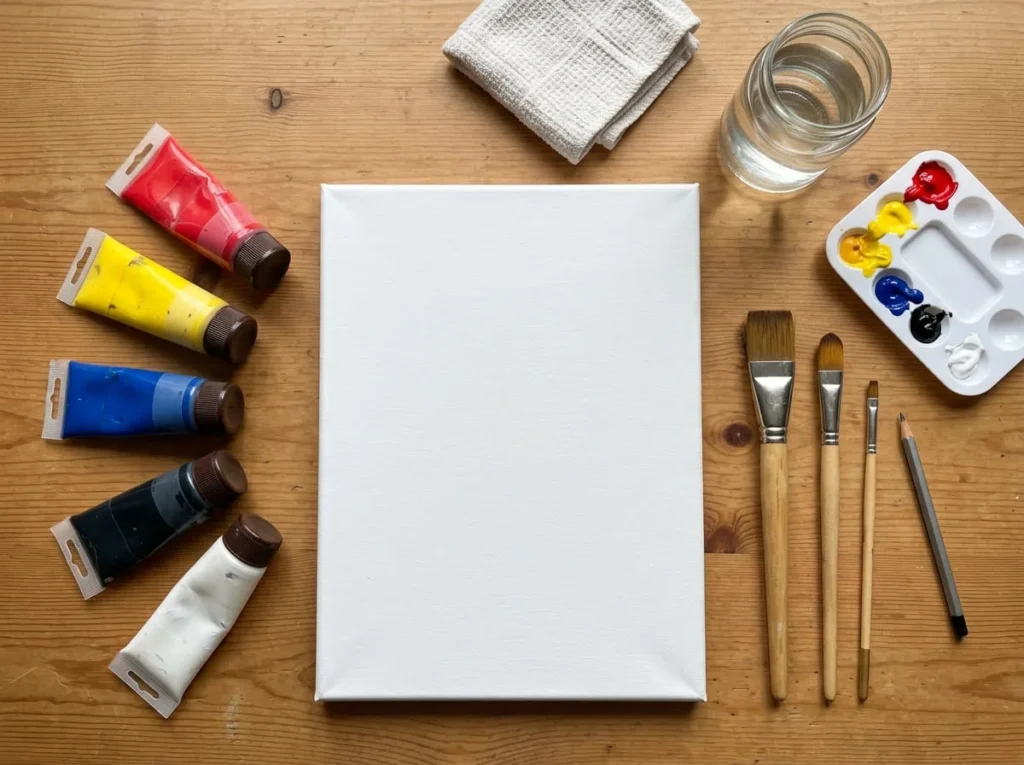
A few basic brushes are enough for most beginner acrylic paintings.
A flat brush is useful for backgrounds, broad color areas, and simple straight strokes.
A medium round brush works well for flowers, curved shapes, and general painting.
A small detail brush helps you create thin stems, outlines, stars, and other tiny decorations.
You will also need a palette or suitable plate for mixing colors, a container of clean water for rinsing brushes, and a cloth or paper towel for removing extra moisture.
Protect your worktable with reusable craft material or paper.
Keep your supplies organized so you can move between colors without unnecessary interruptions.
Do You Need Gesso Before Painting?
Gesso is a preparation coating that helps create a suitable surface for painting.
Many ready-to-paint canvases are already primed, which means you can usually apply acrylic paint directly without adding another layer of gesso.
However, not every canvas is sold ready for painting.
Raw, unprimed canvas generally needs an appropriate acrylic painting ground before you begin.
If you are unsure, check the canvas packaging or manufacturer’s instructions.
For your first acrylic painting, choosing a pre-primed canvas is the simplest option.
How to Prepare Your Canvas for Acrylic Painting
Preparing your painting area and canvas before starting can help you avoid unnecessary mistakes.
The process is simple and usually takes only a few minutes when you are using a ready-to-paint canvas.
Follow these steps before choosing one of the painting ideas below.
Step 1: Check Whether Your Canvas Is Primed
Start by checking whether your canvas has been prepared for acrylic painting.
Many beginner canvases have a white primed surface that is ready for paint.
Look at the product packaging to confirm this.
If your canvas is unprimed, prepare it using a suitable acrylic ground according to the product instructions.
Avoid assuming that every white-looking canvas has the same surface preparation.
Step 2: Set Up Your Painting Area
Choose a comfortable, well-lit place to paint.
Cover your worktable to protect it from accidental paint marks.
Place your canvas on a stable surface where it will not slide while you work.
Keep your brushes, paint, water container, and cleaning cloth within easy reach.
Make sure you have enough room to move your hand comfortably.
A clean workspace can help you concentrate on painting and reduce accidental spills.
Step 3: Choose Your Colors and Simple Design
Before applying paint, decide what you want to create.
For your first project, choose a simple design with a few large shapes.
You might paint a flower, a rainbow arch, or an abstract pattern.
Select the colors you want to use and place small amounts on your palette.
Avoid squeezing out too much paint because acrylic paint can dry on the palette while you work.
You can add more whenever necessary.
Step 4: Sketch the Main Shapes Lightly
Some painting ideas are easier when you sketch the main shapes first.
Use a pencil to draw simple guidelines on the prepared canvas.
For example, you can sketch a large flower, mark a mountain outline, or draw the basic position of a rainbow.
Keep the pencil marks light so they are easier to cover with paint.
You do not need to draw every small detail.
A simple sketch is enough to guide your first brush strokes.
Step 5: Prepare Your Brushes and Paint
Before painting, check that your brushes are clean.
If needed, lightly moisten a brush with water and remove excess moisture with a cloth.
Place the colors you need on your palette.
Test a few brush strokes on scrap paper or a spare painting surface to become comfortable with the paint.
Avoid loading the brush with too much paint at once.
Once your materials are ready, you can begin creating your artwork.
15 Easy Canvas Painting Ideas with Acrylic Paint
You do not need to begin with complicated portraits or detailed landscapes.
Some of the most attractive beginner canvas paintings use simple shapes, a small number of colors, and easy brush techniques.
The following ideas are designed to help you build confidence while creating artwork you can display at home.
Each project includes suggested colors, basic painting steps, and a useful tip to make the process easier.
1. Easy Abstract Color Block Painting

Difficulty: Very easy | Suggested colors: Blue, cream, yellow, and muted pink
Abstract color block painting is one of the easiest acrylic painting ideas for beginners because it does not require realistic drawing.
Instead of painting objects, you create a design using large colorful shapes.
You can combine rectangles, curved sections, and irregular forms to make modern decorative artwork.
This project is useful for practicing brush control and applying smooth colors.
How to Paint Simple Abstract Color Blocks
1. Start with a pre-primed canvas and choose a light cream color for the background.
2. Use a flat brush to paint the background evenly. Allow it to dry before adding new shapes.
3. Lightly sketch three or four large shapes using a pencil. Try combining a blue rectangle, a muted pink curved shape, and a smaller yellow section.
4. Fill each shape with acrylic paint using controlled brush strokes.
5. Allow neighboring colors to dry when necessary so the edges remain distinct.
6. Once the main colors are dry, check whether any areas need another thin coat.
You can leave some of the cream background visible between the shapes.
This creates breathing room and keeps the painting from looking too crowded.
Beginner tip: Start with only three or four large shapes. Simple arrangements are easier to balance than designs containing many small sections.
2. Simple Daisy Flower Painting

Difficulty: Very easy | Suggested colors: White, yellow, green, and light blue
Daisies are a lovely subject for beginners because their shapes are simple and easy to recognize.
You can paint one large daisy in the center of your canvas or create a small group of flowers.
The rounded petals and bright yellow centers make the painting cheerful without requiring complicated details.
This is also a useful project for practicing round brush strokes.
How to Paint Daisies with Acrylic Paint
1. Paint the canvas with a soft light blue background using a flat brush.
2. Allow the background to dry before adding the flowers.
3. Use a small round brush and green acrylic paint to draw a simple curved stem.
4. Add two or three oval green leaves along the stem.
5. Mark a small circle near the top of the stem to guide the flower’s center.
6. Use white acrylic paint to create rounded petals around the circle. Paint each petal with a short, controlled stroke.
7. Once the white petals have dried enough for another color, fill the center with yellow paint.
8. Add a few small details if you want, but keep the flower simple.
You can paint additional daisies using the same technique.
Beginner tip: Do not worry about making every petal identical. Slight differences can help your flowers look naturally handmade.
3. Easy Sunset Painting on Canvas

Difficulty: Easy | Suggested colors: Yellow, orange, pink, purple, and black
Sunsets are popular beginner acrylic painting subjects because they allow you to explore beautiful colors without drawing complicated objects.
A simple sunset painting can include a warm sky with a dark landscape along the bottom.
You can make the design as simple or colorful as you like.
This project is especially useful for learning how to blend nearby acrylic colors while they are still workable.
How to Paint a Beginner Sunset
1. Place your canvas on a stable surface and prepare yellow, orange, pink, and purple acrylic paint.
2. Start near the bottom of the sky with a band of yellow.
3. Add orange directly above the yellow area.
4. Continue with pink and then purple toward the upper part of the canvas.
5. While neighboring paint areas are still workable, gently blend their edges using a clean, lightly damp brush.
6. Avoid repeatedly brushing the same area because excessive mixing can create muddy colors.
7. Allow the sky to dry.
8. Use black or a very dark purple to paint a simple land silhouette along the bottom of the canvas.
9. Add one or two small hills if you want a little more detail.
You can also paint a simple sun near the horizon, using a light color that remains visible against the background.
Beginner tip: Use a small number of colors and work on the sky in manageable sections. Acrylic paint can dry quickly, especially when applied in thin layers.
4. Simple Mountain Silhouette Painting
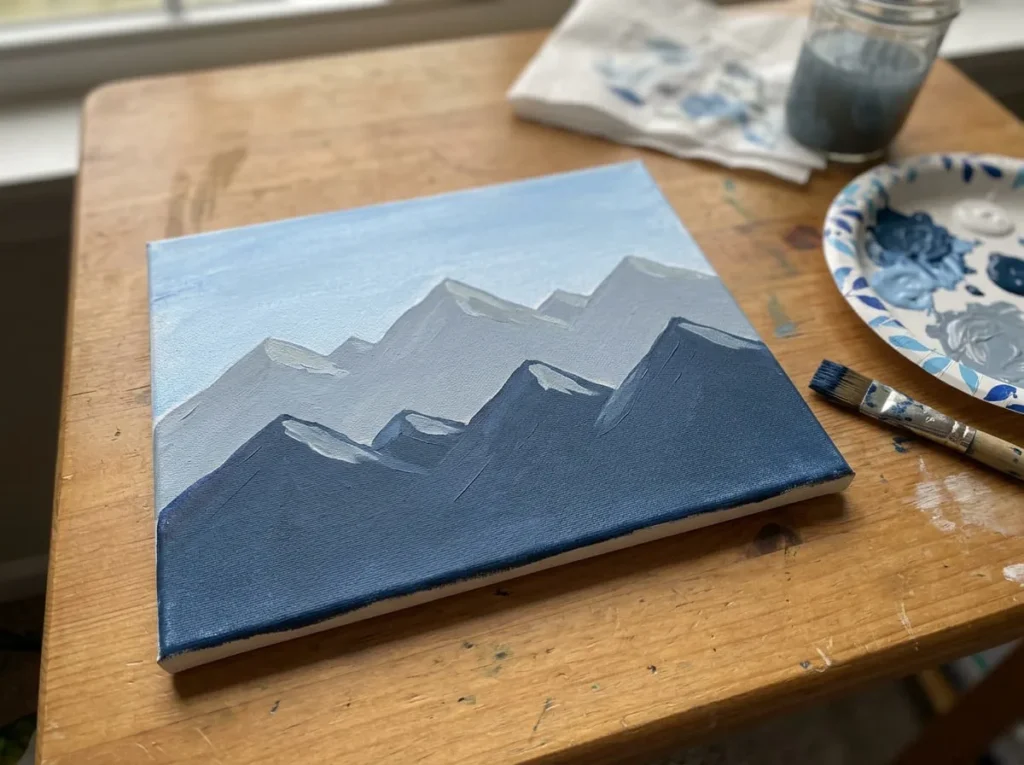
Difficulty: Easy | Suggested colors: Pale blue, dark blue, white, and gray
Mountain paintings are a good choice for beginners because mountains can be created using simple uneven shapes.
You do not need to paint realistic rocks, trees, or detailed landscapes.
A few overlapping mountain layers can create a peaceful scene with a sense of distance.
This idea also helps you practice using light and dark colors to create depth.
How to Paint Easy Acrylic Mountains
1. Begin by painting the canvas with a pale blue sky.
2. Allow the background to dry before adding your mountain shapes.
3. Mix a soft gray-blue color using blue, white, and a small amount of gray or black.
4. Paint a row of distant mountains across the middle of the canvas. Use simple uneven peaks.
5. Allow the distant layer to dry before adding the next mountain range.
6. Mix a darker blue or gray for the mountains closer to the viewer.
7. Paint the second mountain layer slightly lower, allowing some of the lighter mountains to remain visible behind it.
8. Add a few small highlights if you want, but avoid making every mountain look identical.
For a very simple version, use only two mountain layers and one background color.
Beginner tip: Paint distant mountains with lighter, softer colors and closer mountains with darker shades. This helps create depth without complicated shading techniques.
5. Colorful Rainbow Arch Painting

Difficulty: Very easy | Suggested colors: Pink, orange, yellow, green, and blue
Rainbow arch paintings are simple, colorful, and especially suitable for beginners who enjoy modern decorative artwork.
The design consists of several curved bands of color arranged in a rainbow shape.
You do not need advanced blending skills because each color can remain separate.
This makes the project a good choice for practicing smooth curves and brush control.
How to Paint Rainbow Arches on Canvas
1. Choose a warm white or cream background for your canvas.
2. Apply the background color evenly and allow it to dry.
3. Lightly sketch a large arch shape in the center using a pencil.
4. Draw additional curved guidelines inside the first arch to create separate bands.
5. Begin with the outer band using pink acrylic paint and a suitable flat or round brush.
6. Continue painting the next bands using orange, yellow, green, and blue.
7. Work slowly around the curves and use controlled strokes to maintain a consistent shape.
8. Allow adjacent colors to dry when necessary to prevent unwanted mixing.
9. Once the painting is dry, use a small brush to correct uneven edges or fill any gaps.
You can keep the arch centered or place it slightly toward one side for a different composition.
Beginner tip: Do not rush to paint every color while the previous band is still wet. Allowing the bands to dry when needed makes it easier to keep the colors clean and separate.
6. Easy Night Sky with Stars

Difficulty: Easy | Suggested colors: Navy blue, purple, white, and black
A starry night sky is a beautiful acrylic painting idea for beginners who enjoy dark colors and simple designs.
You do not need to paint complicated clouds, planets, or realistic stars. A dark background with a few bright dots can create a peaceful nighttime scene.
This project is also a good way to practice blending dark colors and adding small details with a fine brush.
How to Paint a Simple Starry Sky
1. Start with a pre-primed canvas and prepare navy blue, purple, black, and white acrylic paint.
2. Use a flat brush to cover the background with dark blue paint.
3. While the blue paint is still workable, add small areas of purple and gently blend them into the background.
4. Add a little black around the upper corners if you want to create a darker appearance.
5. Allow the background to dry before painting the stars.
6. Dip a small detail brush into white acrylic paint and add tiny dots across the sky.
7. Make some stars slightly larger than others to create natural variation.
8. For a few brighter stars, paint two short crossing lines around a white dot.
You can also add a simple dark hill along the bottom of the canvas if you want a landscape effect.
Keep the details limited so the stars remain the main focus.
Beginner tip: Start with fewer stars than you think you need. You can always add more, but too many white dots may make the painting look crowded.
7. Simple Ocean and Beach Painting
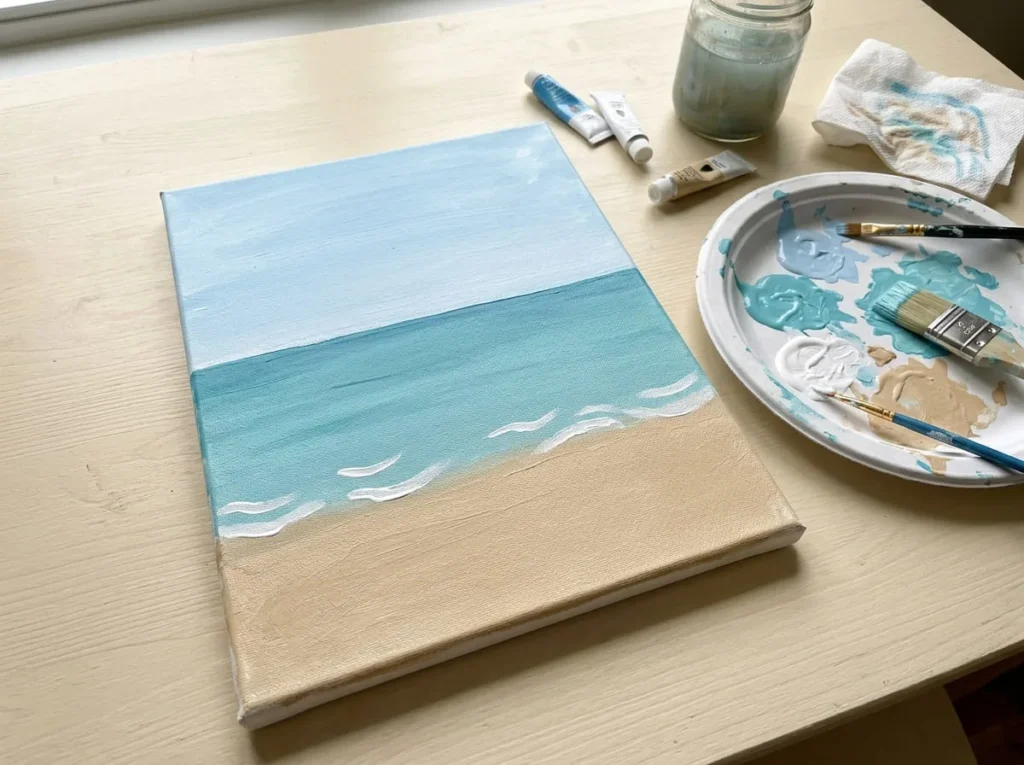
Difficulty: Easy | Suggested colors: Blue, turquoise, white, and sandy beige
A simple beach painting can bring a calm and relaxing feeling to your artwork.
You can create a recognizable beach scene using only three main areas: the sky, the ocean, and the sand.
This is an easy landscape painting with acrylics because you do not need realistic waves or complicated water reflections.
The main goal is to use gentle colors and clear shapes.
How to Paint an Easy Beach Scene
1. Place your canvas on a flat, protected surface and prepare your chosen colors.
2. Lightly draw a horizontal guideline to separate the sky from the ocean.
3. Paint the upper section with a soft light blue color.
4. Once the sky is ready, paint the ocean area using a slightly deeper blue or turquoise shade.
5. Create a sandy beach along the lower portion of the canvas using beige acrylic paint.
6. Allow the main color sections to dry before adding details.
7. Use a small brush and white paint to create a few thin, gently curved wave lines near the shoreline.
8. Add a slightly darker blue line near the horizon if you want to create more depth.
You can keep the beach empty or add one or two small details, such as a simple seashell shape.
Avoid adding too many objects during your first attempt.
Beginner tip: Keep the horizon reasonably straight and use only a few wave lines. A simple beach scene often looks more balanced than one filled with unnecessary details.
8. Minimalist Leaf Painting
Difficulty: Very easy | Suggested colors: Cream, olive green, sage green, and dark green
Minimalist leaf paintings are a lovely choice for beginners who prefer natural colors and simple home decorations.
Instead of painting a detailed plant, you can create one or two curved branches with basic oval leaves.
This project is useful for practicing thin lines and gentle brush movements.
It also teaches you how to arrange a design without filling every part of the canvas.
How to Paint Simple Leaves on Canvas
1. Paint your canvas with a light cream background and allow it to dry.
2. Use a pencil to sketch one long, gently curved stem near the center of the canvas.
3. If you want a second branch, draw it slightly to one side.
4. Use a small round brush and dark green acrylic paint to follow the stem outlines.
5. Add oval leaf shapes along both sides of each stem.
6. Fill the leaves using olive green and sage green paint.
7. Allow the leaves to dry before adding any small highlights.
8. Use a lighter green shade to add subtle color variation to a few leaves.
You do not need to paint every leaf with the same shape or size.
Leaving plenty of empty background space can make the artwork feel calm and balanced.
Beginner tip: Start with one main leafy branch. A simple botanical design is easier to paint when you focus on a few clear shapes instead of many overlapping leaves.
9. Easy Lavender Flower Painting

Difficulty: Easy | Suggested colors: Lavender, purple, green, and warm white
Lavender flowers are a great subject for beginner acrylic painting because you can create them using small brush marks rather than detailed petals.
Their long stems and colorful flower clusters make them easy to recognize.
You can paint a small group of lavender stalks against a light background to create simple floral artwork.
This painting also helps you practice using the tip of a brush to make repeated marks.
How to Paint Lavender with Acrylics
1. Cover your canvas with a warm white background and allow it to dry.
2. Lightly sketch three or five tall stems rising from the lower part of the canvas.
3. Use a small detail brush and green acrylic paint to draw the stems.
4. Add a few narrow leaves near the lower sections.
5. Dip a small round brush into lavender paint and make short dabs along the upper part of each stem.
6. Place the purple marks close together to create the appearance of small flower clusters.
7. Add a few darker purple dabs to give the flowers more color variation.
8. Once the paint is dry, check whether any stems or leaves need small finishing details.
Try making the flower clusters slightly different in height so the arrangement looks natural.
You can also leave open space around the flowers instead of filling the entire canvas.
Beginner tip: Focus on the overall lavender shape rather than painting individual tiny petals. Small grouped brush marks are enough to create a recognizable flower.
10. Simple Tree Silhouette Painting
Difficulty: Easy | Suggested colors: Orange, yellow, pink, and dark brown
A tree silhouette against a colorful sunset is a simple way to create dramatic canvas artwork without painting detailed leaves or bark.
The bright background creates contrast, while the dark tree shape becomes the main subject.
You can make the painting with one tree, a few branches, and simple foliage.
This project is useful for practicing silhouettes and understanding how dark shapes can stand out against lighter colors.
How to Paint a Tree Against a Sunset
1. Start with a pre-primed canvas and choose yellow, orange, and pink for the sky.
2. Paint the lower sky with yellow acrylic paint.
3. Add orange above the yellow and pink toward the top of the canvas.
4. Gently blend the neighboring colors while they are still workable.
5. Allow the sunset background to dry completely before adding the tree.
6. Use a small or medium round brush and dark brown paint to create a tree trunk rising from the bottom of the canvas.
7. Add a few main branches extending outward from the trunk.
8. Use a smaller brush to paint thinner branches.
9. Add simple dark leaf clusters with short dabbing strokes if you want a fuller tree.
10. Check the overall silhouette and fill any gaps that make the trunk or main branches look disconnected.
The tree does not need to be perfectly symmetrical.
A slightly uneven shape can make it look more natural.
Beginner tip: Paint the trunk and main branches first. Once the basic tree shape looks balanced, add smaller branches and foliage without overcrowding the scene.
11. Easy Geometric Shapes Painting
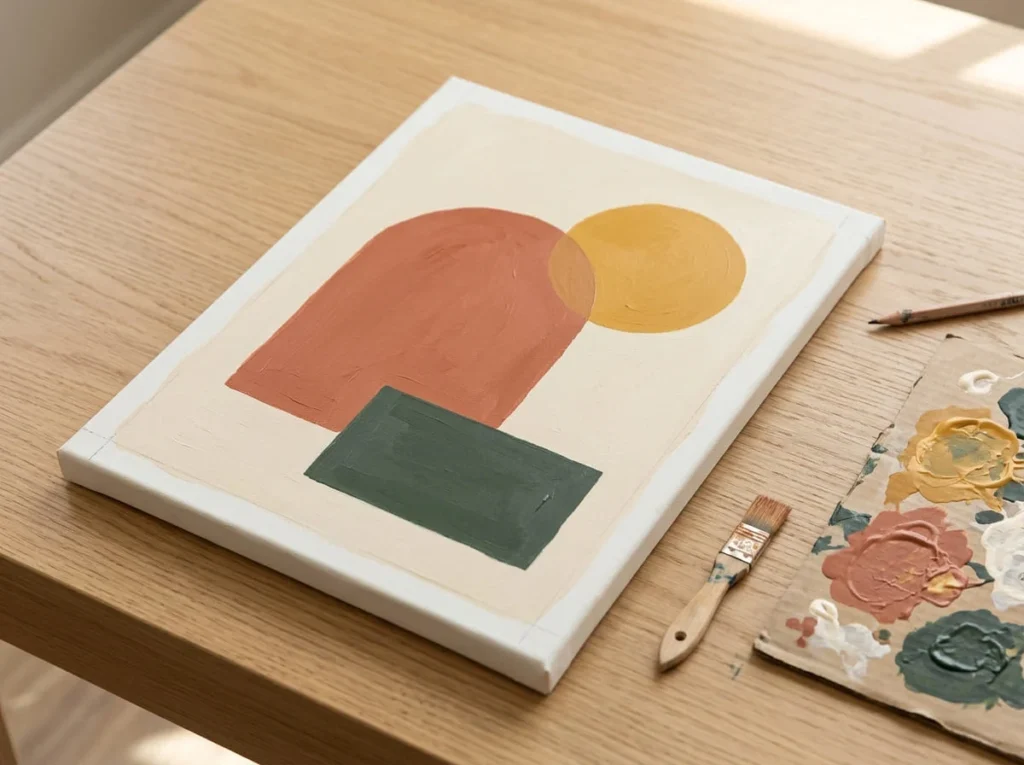
Difficulty: Very easy | Suggested colors: Terracotta, cream, mustard, and dark green
Geometric canvas painting is an excellent choice for beginners who enjoy modern and colorful artwork.
You can create attractive designs using circles, rectangles, arches, and other simple shapes.
Unlike realistic paintings, geometric art does not require shading, perspective, or complicated brush techniques.
It is also easy to personalize with colors that match your room.
How to Paint Simple Geometric Art
1. Paint the canvas with a cream background using a flat brush.
2. Allow the background to dry before sketching your design.
3. Lightly draw three or four large geometric shapes using a pencil.
4. Try placing a terracotta arch on one side, a mustard circle near the center, and a dark green rectangle toward the bottom.
5. Use a suitable flat or round brush to fill each shape with acrylic paint.
6. Work slowly around the edges to keep the shapes clear.
7. If you want straight edges, use painter’s tape suitable for the prepared canvas and follow its removal instructions.
8. Allow the painted shapes to dry before adding another color over them.
9. Use a small detail brush to correct uneven edges when necessary.
You can allow some shapes to overlap or leave small areas of the cream background visible between them.
Choose an arrangement that looks balanced without making every shape the same size.
Beginner tip: Use only three or four colors for your first geometric painting. A limited palette makes it easier to create a clean, coordinated design.
12. Simple Butterfly Silhouette Painting
Difficulty: Easy | Suggested colors: Pink, peach, lavender, and dark purple
A butterfly silhouette is a beautiful acrylic painting idea for beginners because it uses simple shapes and a small number of colors.
You do not need to paint realistic wings or complicated patterns. A butterfly with two large upper wings, two smaller lower wings, and a narrow body can create an attractive design.
This painting is especially useful for practicing symmetry, curved outlines, and careful brush control.
How to Paint an Easy Butterfly
1. Start with a pre-primed canvas and paint the background with a soft peach or light pink color.
2. Allow the background to dry before sketching your butterfly.
3. Lightly draw a vertical guideline near the center of the canvas to help position the body.
4. Sketch two large rounded upper wings on opposite sides of the guideline.
5. Add two smaller lower wings beneath them, keeping the overall shape reasonably balanced.
6. Use dark purple acrylic paint and a small round brush to fill the butterfly shape, including the body and wings.
7. Once the main shape has dried, add a few lavender or pink dots inside the wings if you want more decoration.
8. Paint two short, curved antennae above the butterfly’s head using a detail brush.
9. Check the wing outlines and carefully correct any uneven areas after the paint dries.
You can keep the butterfly completely dark for a simple silhouette or add a few small colorful details.
Beginner tip: Sketch the wings before painting. They do not need to be perfectly identical, but a clear central guideline can help you create a balanced shape.
13. Easy Moon and Clouds Painting
Difficulty: Easy | Suggested colors: Dark blue, purple, white, and gray
A moon and clouds painting is a peaceful idea for beginners who enjoy nighttime scenes.
You can create an attractive painting with a dark background, one large moon, and a few soft clouds.
The design does not require detailed drawing or realistic lighting effects.
This project helps you practice painting circular shapes, layering colors, and creating softer edges with a brush.
How to Paint a Moonlit Sky
1. Cover your canvas with dark blue acrylic paint using a flat brush.
2. Add a small amount of purple to certain areas while the background remains workable.
3. Blend the colors gently to create a simple nighttime sky.
4. Allow the background to dry before painting the moon.
5. Lightly sketch a circle near the upper part of the canvas.
6. Use white acrylic paint and a medium round brush to fill the circle.
7. Mix a small amount of gray with white and add a few subtle marks inside the moon to create simple surface texture.
8. Use a clean brush with a small amount of white and gray paint to create two or three soft cloud shapes.
9. Gently soften the cloud edges while the paint is still workable.
10. Allow the painting to dry before deciding whether it needs small highlights.
Keep the clouds simple and leave enough dark sky visible around the moon.
Beginner tip: Use only a little paint when softening cloud edges. Too much paint or repeated brushing can make the clouds look like large solid patches.
14. Colorful Heart Canvas Painting
Difficulty: Very easy | Suggested colors: Pink, red, cream, and lavender
A colorful heart painting is one of the easiest things to create on canvas with acrylic paint.
You can make the design using one large heart and a simple background.
This project is suitable for beginners who want to practice painting smooth shapes without learning complicated techniques.
You can also change the colors to make a handmade decoration for your bedroom, a gift, or a special occasion.
How to Paint a Simple Heart Design
1. Begin with a clean, pre-primed canvas.
2. Paint the background with a light cream color using a flat brush.
3. Allow the background to dry completely.
4. Lightly sketch one large heart near the center of the canvas.
5. Use pink or red acrylic paint to carefully outline the heart with a small round brush.
6. Fill the inside using a slightly larger brush and controlled strokes.
7. Allow the first coat to dry before applying another thin layer if the coverage looks uneven.
8. Add a few small lavender dots or a simple curved line around the heart if you want a decorative touch.
9. Once the artwork is dry, correct any uneven edges with a detail brush.
You can also paint the heart in lavender against a soft pink background for a different appearance.
Beginner tip: Make one large heart the main focus of your painting. Adding too many smaller hearts and decorative shapes can make the composition feel crowded.
15. Easy Wildflower Meadow Painting

Difficulty: Easy | Suggested colors: Light blue, green, yellow, pink, and white
A wildflower meadow painting is a cheerful beginner project that combines simple landscape shapes with colorful flowers.
You do not need to paint realistic plants or individual blades of grass.
A light blue sky, a green field, and a few small flower shapes are enough to create a recognizable meadow.
This project also helps you practice layering and adding small details over a painted background.
How to Paint a Simple Wildflower Meadow
1. Start by painting the upper portion of your canvas with light blue acrylic paint.
2. Use a flat brush to cover the lower section with a medium green color, creating a simple grassy field.
3. Allow the main background colors to dry before adding flowers.
4. Use a small detail brush and dark green paint to draw several short stems rising from the grassy area.
5. Add small pink, yellow, and white dots near the tops of the stems to represent flowers.
6. For a few larger flowers, paint five rounded petals around a tiny contrasting center.
7. Add short, thin green strokes near the lower part of the canvas to suggest grass.
8. Place some flowers in small groups, leaving spaces between them.
9. Once the paint is dry, add a few lighter green strokes to create subtle variation in the field.
You can make the flowers different heights and colors to give the meadow a natural handmade appearance.
Beginner tip: Avoid placing every flower in a straight line. Small groups at different heights can make your meadow look more interesting without requiring advanced painting skills.
Basic Acrylic Painting Techniques Every Beginner Should Know
Learning a few basic acrylic painting techniques can make your canvas projects much easier.
You do not need to master complicated methods before starting. Simple blending, layering, and brush control are enough for many beginner paintings.
How to Blend Acrylic Paint on Canvas
Blending helps you create gentle transitions between colors.
For example, you can blend yellow into orange when painting a sunset or combine blue and purple for a night sky.
Place neighboring colors on the canvas while they are still workable.
Use a clean, slightly damp brush to gently soften the area where the colors meet.
Avoid brushing repeatedly because too much mixing can make the colors look muddy.
If the paint has already dried, apply a fresh compatible layer rather than trying to reactivate the dry paint with water.
How to Paint Smooth Backgrounds
A smooth background can make simple paintings look more balanced.
Use a flat brush and apply acrylic paint with steady strokes.
Work in manageable sections and avoid loading the brush with too much paint.
Try to maintain a consistent direction while covering the canvas.
If the background looks patchy, allow the first coat to dry before adding another thin layer.
Avoid repeatedly brushing paint that has started drying because this can create uneven marks.
How to Create Simple Layers
Layering allows you to build a painting gradually.
Start with the background, such as a sky or plain colored surface.
After the background has dried sufficiently, add the larger shapes.
For a mountain painting, this means painting the sky first, followed by distant mountains and then darker foreground mountains.
Add small details and highlights near the end.
Working from background to foreground helps keep the process organized and reduces accidental smudging.
How to Make Dots and Small Details
Small details can make a simple acrylic painting more interesting.
Use a fine detail brush for stars, flower centers, thin stems, and decorative dots.
Dip only the tip of the brush into a small amount of paint.
For round dots, touch the brush gently to the canvas and lift it carefully.
If you want a thin line, use light pressure and move your hand steadily.
Practice these marks on scrap paper or a spare painting surface before adding them to your finished artwork.
How to Correct a Painting Mistake
Mistakes are a normal part of learning acrylic painting.
If you paint outside a shape or use the wrong color, avoid rubbing the area repeatedly while it is drying.
Allow the unwanted paint to dry sufficiently.
Then use an appropriate acrylic color to cover the mistake with a thin layer.
Some colors may require additional coats, especially when covering dark paint with a lighter shade.
You can also adjust a shape slightly if that makes the design easier to correct.
Not every mistake needs to be hidden completely. Small variations often add character to handmade paintings.
Common Beginner Mistakes When Painting on Canvas
Acrylic painting becomes easier when you understand a few common problems.
Many beginners experience uneven colors, muddy blending, or difficulty painting small details.
These issues are usually related to paint application, timing, or trying to do too much at once.
Using Too Much Paint at Once
Applying a large amount of acrylic paint can create thick patches, drips, and uneven coverage.
Start with a moderate amount of paint on your brush.
Add more when necessary rather than covering the canvas with a heavy layer immediately.
For simple backgrounds and shapes, thin, controlled coats are often easier to manage.
Adding Too Much Water to Acrylic Paint
Water can help adjust the consistency of certain acrylic paints, but excessive dilution may reduce color coverage.
Depending on the paint formulation and application, adding too much water can also affect how the dried paint film forms.
Follow the manufacturer’s recommendations when thinning acrylic paint.
For beginners, start with a small amount of water only when needed.
If you want a more fluid painting technique, consider using a compatible acrylic medium.
Trying to Blend Paint That Has Already Dried
Unlike watercolor, dried acrylic paint does not normally reactivate when you add water.
If you try to blend a dry layer, you may create unwanted brush marks instead of a smooth transition.
Work with neighboring colors while they are still wet enough to blend.
If the paint has already dried, allow the area to become fully ready for another coat and add fresh paint to create the transition.
Using the Wrong Brush for Small Details
Large brushes can make tiny flowers, thin stems, and small decorative lines difficult to control.
Choose a fine detail brush when working in narrow areas.
For backgrounds and large shapes, use a flat or broader brush.
Matching the brush to the task can make painting more comfortable and help you create cleaner marks.
Making the Painting Too Complicated
One common mistake is adding too many colors, shapes, or details to a beginner project.
A simple painting can look attractive without including every possible decoration.
Start with a clear main subject.
For example, choose one butterfly, one tree, or a small group of flowers rather than filling the entire canvas.
You can experiment with more complicated compositions as your confidence grows.
Painting Over a Wet Layer Too Soon
Applying new paint over a layer that has not dried sufficiently can cause colors to mix unintentionally.
This is particularly noticeable when adding light-colored details over dark backgrounds.
For example, white stars may become bluish if you paint them over a wet blue sky.
Allow the background to dry before adding details that need clean, separate colors.
Follow the paint manufacturer’s drying instructions rather than relying on one fixed waiting time.
How to Dry, Protect, and Display Acrylic Canvas Paintings
Once your painting is complete, proper drying and handling can help protect your artwork.
You do not need complicated finishing equipment for a simple beginner painting, but it is important to understand how acrylic paint behaves after application.
How Long Does Acrylic Paint Take to Dry on Canvas?
Acrylic paint drying time depends on the product, thickness of the paint, temperature, humidity, and airflow.
Thin layers may become touch-dry relatively quickly, while thick areas can take considerably longer.
Paint may also need additional time before it is ready for varnishing or other finishing processes.
Check the manufacturer’s instructions for your specific paint.
Place the canvas somewhere clean and protected while it dries.
Avoid touching painted areas to test them repeatedly.
Do Acrylic Paintings on Canvas Need Varnish?
Not every beginner acrylic canvas painting needs varnish.
A decorative painting displayed indoors may be suitable without an additional protective coating, depending on the materials and intended use.
However, some artists use compatible acrylic varnishes to provide a protective finish or adjust the appearance of the artwork.
Varnishes can have matte, satin, or glossy finishes.
Before applying one, check that it is suitable for your paint and canvas.
Allow the painting to dry or cure as required and test the product on a separate sample if possible.
How to Protect Finished Canvas Art
Handle your finished canvas carefully, especially before the paint has fully dried or cured.
Avoid scratching the surface or placing other objects directly against the artwork.
Keep the painting away from unnecessary moisture and harsh cleaning products.
If you choose to apply a protective coating, follow the manufacturer’s instructions for compatibility, application, and curing.
For ordinary cleaning, use only a method suitable for the finished artwork rather than rubbing the painted surface with a wet cloth.
Simple Ways to Display Your Canvas Painting
You can display your finished acrylic painting on a shelf, a small easel, or a wall.
For a stretched canvas, choose hanging hardware suitable for the frame’s weight and construction.
Canvas panels may need an appropriate frame or display stand.
Place your artwork somewhere it will not be easily knocked over or damaged.
You can also arrange several beginner paintings together to create a small handmade wall art display.
Frequently Asked Questions
What Is the Easiest Thing to Paint on Canvas with Acrylic Paint?
Simple abstract color blocks, daisies, and rainbow arches are among the easiest subjects for beginners. These designs use basic shapes and do not require complicated drawing skills. Start with a few colors and a small number of large shapes before trying more detailed landscapes.
Is Acrylic Paint Good for Beginners?
Yes, acrylic paint is a practical choice for beginners because it works well on properly prepared canvas and supports many painting techniques. You can use it for flat colors, simple blending, layering, and decorative details. It also allows you to paint over many mistakes after the previous layer has dried.
Can You Paint Directly on a Canvas with Acrylic Paint?
Yes, you can usually paint directly on a canvas that has already been primed for acrylic painting. Many ready-to-paint canvases come with a suitable preparation coat. However, raw or unprimed canvas generally requires an appropriate acrylic painting ground before applying paint.
Do You Need to Wet the Canvas Before Acrylic Painting?
No, you do not normally need to wet a pre-primed canvas before using acrylic paint. Many beginner paintings can be completed on a clean, dry surface. Certain painting techniques may involve moisture, but they are not necessary for simple flowers, landscapes, or geometric designs.
How Many Acrylic Paint Colors Do Beginners Need?
Beginners can start with a small collection of basic colors, such as red or magenta, yellow, blue, white, and black. These can be mixed to create additional shades. Green and brown are also convenient if you prefer not to mix them. You do not need a large paint set to complete simple canvas projects.
Can You Use Acrylic Craft Paint on Canvas?
Yes, many acrylic craft paints can be used on properly prepared canvas. However, coverage, consistency, pigment concentration, and durability vary between products. Check the paint manufacturer’s surface recommendations. For basic decorative canvas projects, a suitable acrylic craft paint can be a practical starting point.
How Do You Blend Acrylic Paint Without Making Muddy Colors?
To create smoother blends, choose a small number of compatible colors and work while they are still wet enough to blend. Use a clean brush and gently soften the edges where the colors meet. Avoid repeatedly mixing several colors in the same area because excessive brushing can create muddy results.
Can You Paint Over Mistakes with Acrylic Paint?
Yes, you can often cover mistakes with another acrylic paint layer after the unwanted paint has dried. Use a suitable color and apply it carefully. Some areas may require more than one coat, especially when covering dark paint with lighter colors. Small changes to the design can also help correct mistakes.
How Long Should You Wait Between Acrylic Paint Layers?
The waiting time depends on the paint formulation, thickness, and environmental conditions. Some thin layers become ready for additional painting relatively quickly, while thicker applications need more time. Follow the manufacturer’s instructions and avoid painting over a layer that is still too wet for the technique you want to use.
Do Beginners Need to Seal Acrylic Canvas Paintings?
Not every beginner acrylic canvas painting needs a protective sealer. For simple indoor decorative artwork, additional finishing may be optional. If you want to use varnish, choose a product compatible with your acrylic paint and canvas. Allow the painting to dry or cure properly before applying the finish.
Final Thoughts
Easy canvas painting ideas with acrylic paint offer a fun way to begin painting without needing advanced artistic skills or expensive supplies.
Start with simple projects such as abstract color blocks, daisies, or rainbow arches. Once you feel comfortable using brushes and applying colors, try sunsets, mountains, flowers, and other beginner landscapes.
Focus on learning basic techniques, including layering, blending, and creating simple shapes.
Remember that handmade paintings do not need perfect lines or identical brush strokes to look attractive.
With practice and patience, you can create colorful canvas artwork that reflects your creativity and personal style.